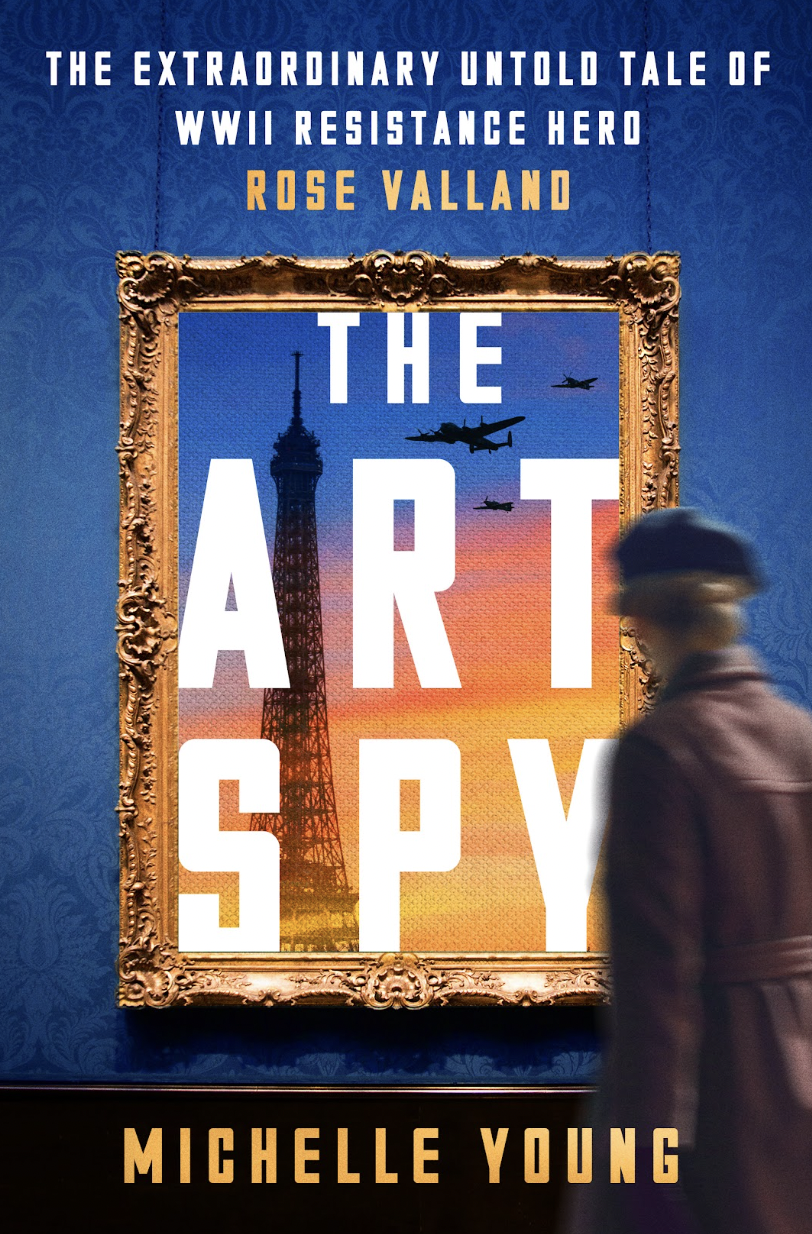
Four Questions to Michelle Young
On May 5, 2026, the Musée d’Orsay opened the “To Whom These Works Belong?” gallery, a new permanent gallery dedicated to MNR (Musées Nationaux Récupération) works. The gallery tells the story of artworks recovered from Nazi Germany and restituted to France at the end of World War Two. Today, 225 MNR works are still in the care of the Musée d’Orsay as their rightful owners have not yet been identified. One woman was instrumental in recovering these works: Rose Valland. Her incredible courage and mission are at the heart of Michelle Young’s latest book.
Michelle Young is an award-winning journalist and author. Her book, The Art Spy: The Extraordinary Untold Tale of World War II Resistance Hero Rose Valland was named a Best Book of 2025 by the New York Public Library, Library Journal, and Hyperallergic.
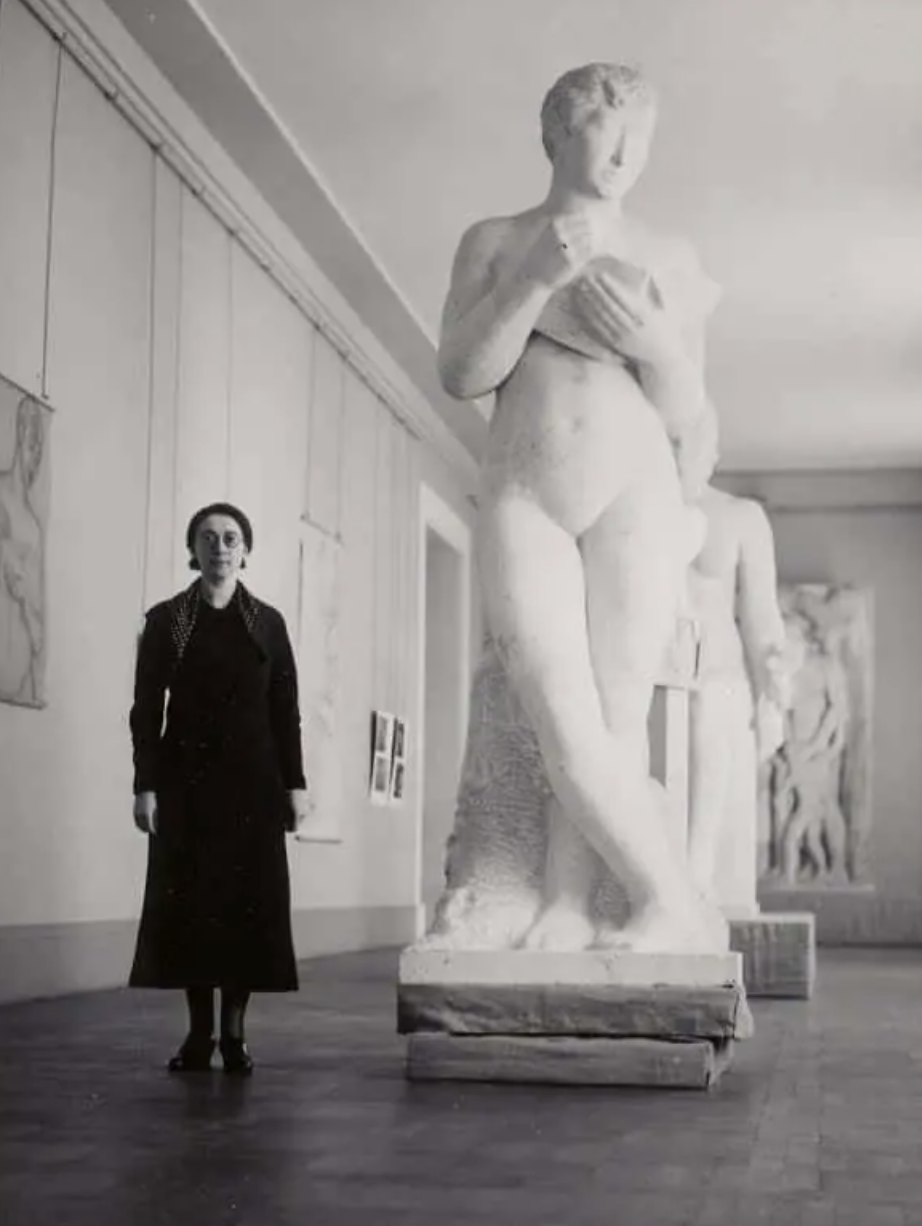
Rose Valland au musée du Jeu de Paume, 1934, © DR
Rose Valland
Throughout the war, one heroine risked her life to secretly and meticulously document the movements of looted art. Her name was Rose Valland. She had assumed charge of the Jeu de Paume in 1938. When the ERR set up their operation at the Jeu de Paume in 1940, she was instructed to remain at her post in order to spy on them. The Nazis being unaware that Valland understood German, she was able to eavesdrop on their conversations, keeping detailed notes on the destinations of stolen art and relaying information to the French Resistance. Following the Liberation of Paris, Valland served in Germany as a Fine Arts officer, ensuring the return of looted artworks to their rightful owners. It is largely thanks to her contribution that the Commission de récupération artistique was able to return 45,000 looted works found in German occupied territories to their rightful owners by 1950.
An Interview with Michelle Young

Michelle Young, photographed by Augustin Pasquet
Q: What inspired you to write a book about Rose Valland?
A: When I discovered Rose Valland, I felt like I was being called to tell her story. I have long been obsessed with female spies in World War II and when I come across their stories, I always wonder what I would have done in their shoes. Rose was the first spy in which I could truly imagine myself acting in similar ways. I felt a real kinship with her as a person and with her background. I also felt that I could see how her brain worked and how she processed information.
But on a deeper level, I understood and identified with the struggles she went through, as someone who was underestimated based on what she looked like and where she came from. At the root, her story is one of an outsider who fights her way to the top of the art world in France and learns to take on multiple identities as needed. Her skills, undervalued in peacetime, become essential in wartime. I very much admired how she fought for her principles, no matter the cost, and how relentless she was. My hunch was that her story, as a woman, as a lesbian, and as someone who didn’t fit any distinct mold, was likely undertold. And that hunch turned out to be correct. All of this exploration turned into the narrative nonfiction book, The Art Spy, which was published by HarperOne.
Q: It is fascinating to see how, once the war was over, she continued her quiet, tireless work, without seeking recognition. What is your view of this second period?
A: Her tireless work did continue but what I learned by going through the enormous amounts of documents she left behind is that she was acutely concerned about her legacy. I’m not sure it is totally accurate to say that she didn’t seek recognition. She was proud of her accomplishments and made sure people she worked with in the Resistance and other important French figures wrote testimonials about her role in the war—which is probably the sole reason why she was awarded the Medaille de Resistance and the Legion d’Honneur at all. She knew she needed to have influential people behind her and she advocated for herself. Most tellingly, she wanted to write a sequel to her memoir about her post-war work but was deliberately silenced by the French government and key figures, while her book was removed from circulation in France. André Francois-Poncet warned her directly not to write the second part of her memoir and in turn, she warned another French Monuments Officer not to write his memoir. We have to remember that when she returned from Germany, the world was in the Cold War. There was an active attempt to put World War II in the rear-view mirror. But Rose wanted to make sure the Nazis who perpetrated the art looting and their collaborators were held to account, and that looted artwork be restituted to their rightful owners. It’s also easy to also forget that in the post war period, Germany restituted a large amount of artwork to the Nazis who stole the artworks, including Hermann Göring’s family! Rose would have found this galling. It was not a rational time and we continue to pay the price for it today.
Q: 80 years after the Nuremberg Trials and almost fifty years after her death, Rose Valland’s work is still at the heart of provenance research. In your opinion, what would she think of the Musée d’Orsay’s provenance research program?
A: I think she would be gratified to know of the efforts of the Musée d’Orsay to shed light on the necessity of provenance research and to bring still-to-be-restituted artworks in the French national collection into public view. She had wrestled with the question of what would happen in the future, particularly when a flood of artworks would re-enter the public market, and she was the person responsible for making sure that Nazi art looting in France was heard and litigated at the Nuremberg trials—she knew that the future or art restitution rested on such a precedent. I like to imagine her at the opening of the gallery, looking on proudly and intently.
Q: Beyond courage and duty, what do you think were the deeper personal motivations that drove Rose Valland to risk her life during the occupation, and to dedicate herself so tirelessly to the restitution of looted artworks for decades after the war?
A: In a cut chapter of Rose’s memoir—which I was able to locate and track down multiple different draft versions of—she makes this motivation explicit. On her harrowing escape out of Paris during the German invasion in 1940, she witnesses a mother who has gone mad, pushing a carriage with two dead children. She says that it’s this moment when she vowed she would fight back in whatever way she could. During the war, she used her deep knowledge of art history and her ability to subsume her identity in different ways to work in the shadows without suspicion. She was also motivated during the war and after by her love of art and her horror at the scale of theft and destruction perpetrated by the Nazis. Restitution was the right thing to do that could partially rectify some of those wrongs and could in part restore the “beauty of the world” that had inspired her from a young age and gave her—a working class woman from a rural village—a career at the pinnacle of the arts world in France.